
Services and Specialties
OCD Treatment & Relief From Intrusive Thoughts
Evidence-Based CBT & ERP to Quiet the Mind and Reclaim Your Life.
If your mind won’t stop generating worst-case scenarios, or you feel stuck in rituals you can’t explain, you’re not alone … and you’re not just “anxious.” Obsessive-Compulsive Disorder (OCD) can be exhausting, confusing, and isolating. It interferes with daily life, decision-making, and even your sense of self.
At Catalyst Psychology, we specialize in Exposure and Response Prevention (ERP), the gold-standard treatment for OCD. ERP is a highly effective form of Cognitive Behavioral Therapy (CBT) that helps you face your fears without relying on compulsive behaviors, so you can break the cycle and move forward with confidence.

What Makes Our Approach Different
We provide a personalized, science-based, and supportive approach to treating OCD. Our goal isn’t just to reduce symptoms—it’s to help you reclaim your time, energy, and ability to live fully in line with your values.
OCD looks different for everyone. Whether your symptoms center on contamination, self-doubt, harm-related fears, or taboo thoughts, we tailor your treatment to match your specific experience and readiness.
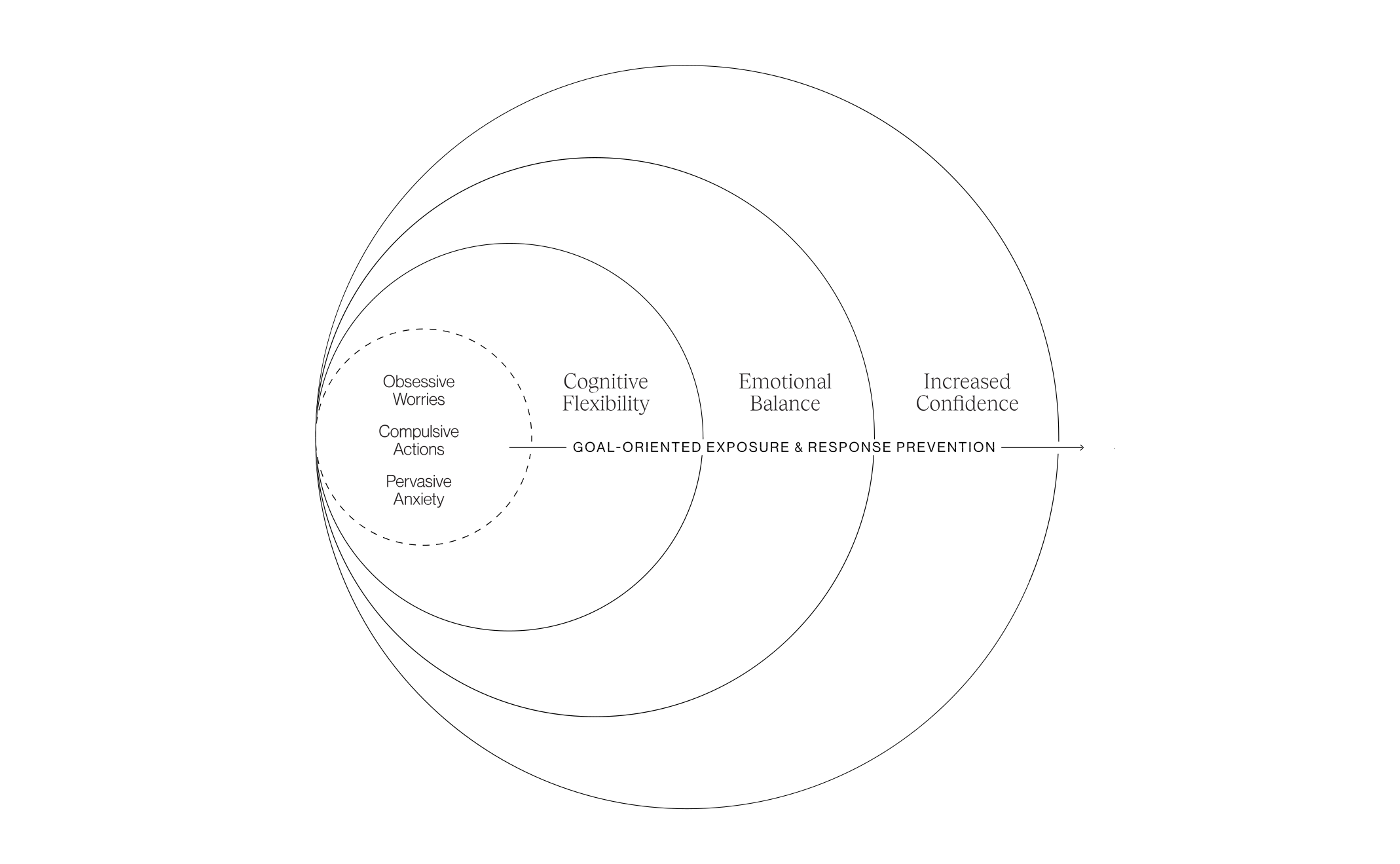
We use Exposure and Response Prevention (ERP)—the gold standard for OCD—integrated with values-based strategies. Our focus isn’t only on facing fears, but on reconnecting with what matters to you. Therapy helps you shift attention away from OCD’s endless demands and toward the routines and relationships that bring purpose and meaning.
OCD is fueled by uncertainty and self-doubt. Our approach is designed not only to reduce distress, but also to help you build trust in your ability to make decisions and live more fully—without rituals, avoidance, or fear running the show.
What You Can Expect from ERP
Many clients report:
01
Reduced frequency and intensity of intrusive thoughts
02
More freedom in daily routines and relationships
03
Less time spent managing rituals or mental rules
04
Greater clarity, confidence, and emotional energy
05
A renewed ability to enjoy life without OCD taking the lead
Who We Help
Catalyst helps adults with OCD patterns that can become time-consuming, mentally exhausting, and difficult to interrupt alone. Treatment focuses on understanding the loop, reducing compulsive responses, and building more freedom around uncertainty.
Intrusive Thoughts and Uncertainty
We work with adults who experience unwanted intrusive thoughts, doubt, or uncertainty that feels difficult to dismiss. This may include fears that feel disturbing, repetitive, “out of character,” or hard to let go of without checking, reviewing, or seeking reassurance.
Distressing intrusive thoughts
Doubt that feels urgent or hard to resolve
Fear of making the wrong choice
Replaying events to feel certain
Needing reassurance before moving forward
Checking, Reassurance, and Mental Reviewing
OCD is not always visible. For many adults, compulsions happen internally through reviewing, analyzing, researching, neutralizing, or trying to “figure it out” until things feel safe enough. Therapy helps you identify these loops and practice responding differently.
Mental checking or reviewing
Reassurance-seeking
Excessive online researching
Re-reading, rechecking, or retracing steps
Trying to neutralize or undo a thought
Avoidance and Life Disruption
OCD can quietly shape daily life by narrowing choices, delaying decisions, increasing avoidance, or making ordinary moments feel loaded with risk. We help adults reduce the patterns that keep OCD in charge and move toward more flexible, values-based action.
Avoiding people, places, tasks, or decisions
Delaying action until certainty feels possible
Rituals that consume time or energy
Difficulty staying present
Feeling pulled away from work, relationships, rest, or daily life
Tools We Use in OCD Treatment
+Exposure and Response Prevention (ERP)
The gold standard for OCD, ERP helps you gradually face feared thoughts and reduce compulsions while you increase actions that get you closer to your goals.
+CBT for thought patterns
Learn to recognize and challenge cognitive distortions that keep OCD in place.
+Behavioral experiments and mindfulness tools
Build distress tolerance and shift your relationship to uncertainty.
+Family learning and support
We regularly help clients educate their families about OCD and build supportive, goal-aligned routines at home—so loved ones can become allies in the process of moving toward what matters and away from OCD’s control.
+Structured planning and support
Your treatment plan is clear, collaborative, and adapted over time.
Frequently Asked Questions About OCD Treatment, ERP Therapy, & Intrusive Thoughts
What is ERP, and why is it the gold-standard treatment for OCD?
Exposure and Response Prevention (ERP) is the most effective, research-backed treatment for OCD. It helps you gradually face feared thoughts, situations, or sensations while resisting the urge to perform compulsions. Over time, your brain learns that anxiety naturally decreases without rituals, giving you more control and reducing the power and frequency of intrusive thoughts.
How do I know if my intrusive thoughts are really OCD?
Intrusive thoughts and images related to OCD are often unwanted, repetitive, and deeply distressing—especially when they go against your values or feel “out of character.” They may trigger mental reviewing, reassurance seeking, or compulsions aimed at reducing fear. A trained OCD therapist can help differentiate OCD from generalized anxiety, trauma, or other conditions and provide a clear, accurate treatment plan.
What happens during ERP sessions at Catalyst Psychology?
ERP sessions are collaborative, structured, and tailored to your specific fears and compulsions. Together, you create a hierarchy of exposures, practice facing triggers in a safe and intentional way, and learn how to resist rituals and mental compulsions. You’ll also build skills for tolerating uncertainty, reducing avoidance, and reclaiming daily routines that OCD has disrupted.
Does ERP mean I'll have to do exposures that feel overwhelming?
No. ERP is never about forcing or surprising you. All exposures are planned together, introduced gradually, and done at a pace that feels challenging but manageable. You are in control throughout the process. The goal is to build confidence and resilience—not to flood you with anxiety.
Can ERP help with mental compulsions like rumination or reassurance seeking?
Absolutely. Many people experience “invisible” compulsions such as analyzing thoughts, mentally reviewing events, self-reassuring, or trying to gain certainty. ERP is highly effective for these internal patterns. You’ll learn how to label mental rituals, interrupt the cycle, and shift your relationship to uncertainty so intrusive thoughts lose their grip.
Do you involve partners or family members in OCD treatment?
Yes, when helpful. Family members often unintentionally participate in reassurance or accommodation that keeps OCD cycles in motion. Catalyst offers optional family sessions to share information about OCD, teach supportive responses, and help loved ones become allies in your progress. Involvement is flexible and based on your goals.
CBT for OCD
OCD often shows up as self-doubt, intrusive thoughts, or compulsions that steal time and energy.
Our clients have described these changes:

I have tools now. When the doubts come up, I know how to respond instead of spiraling.”

OCD just doesn’t have the power it did before, I can pivot from it now.”
I used to lose hours stuck in my head. That time is mine again.”

I have tools now. When the doubts come up, I know how to respond instead of spiraling.”